
From scorecard to decision

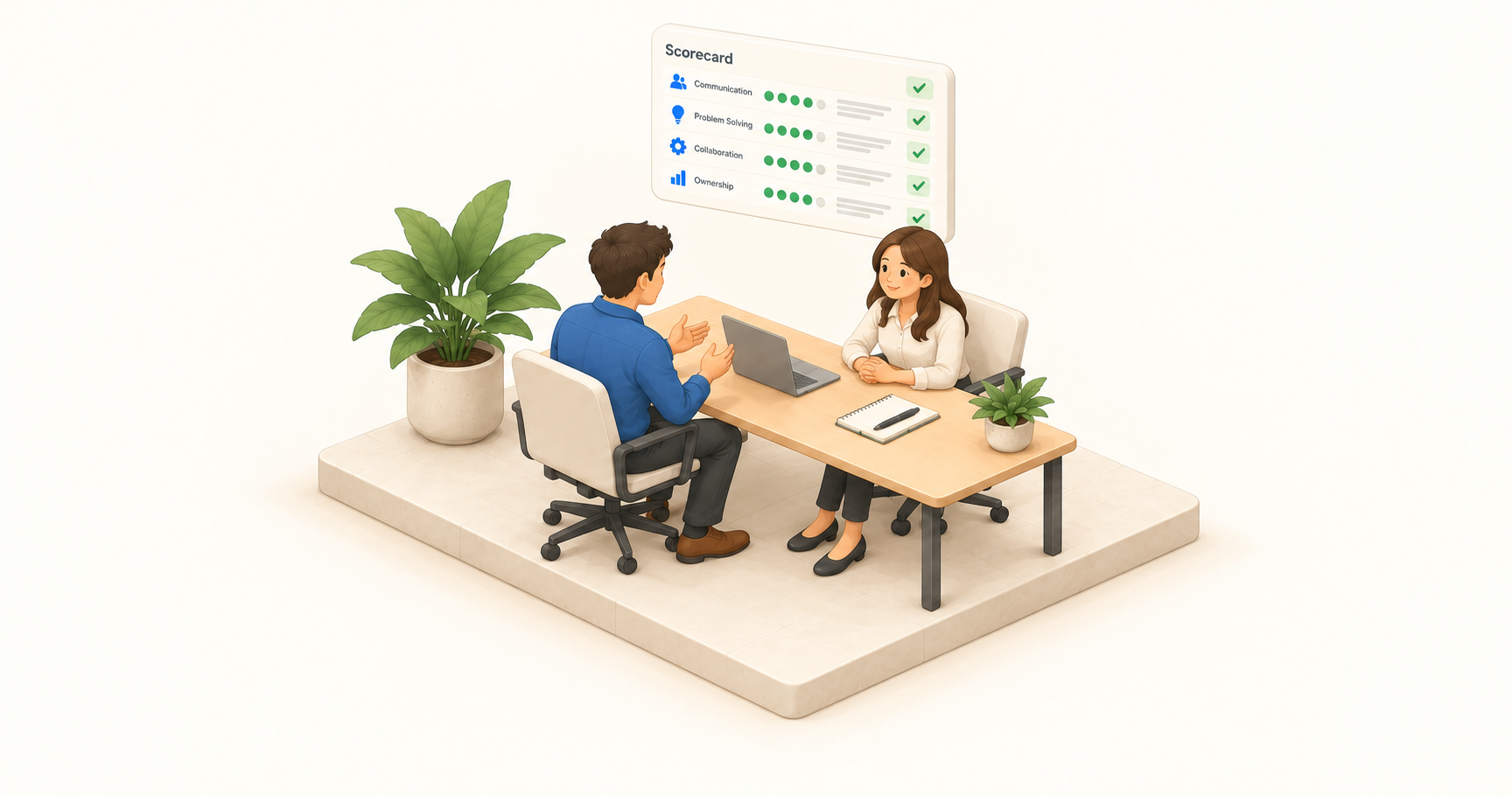
The interview usually goes fine. Hires get lost in the decisions around it.
By the Messa Product team
Hiring doesn't only fail because someone asked the wrong question in an interview. It fails because the decisions around the interview are vague, inconsistent, or never written down. By the time the team meets to decide, the strongest evidence has already been blurred by memory and opinion.
Where hiring actually breaks
A scorecard on its own is just one person's opinion. It becomes useful when it helps the team answer the next question: should this candidate move forward, pause, or be rejected, and why?
Before building Messa, we spent years hiring for a living: engineers, designers, product managers, at companies of every size. In every team we've seen, the process falls apart in the decisions around the interview. Scorecards come in super late, opinions live in Slack threads, and the debrief is decided in 45 minutes by whoever speaks first. And by then, the candidate has accepted another offer.
It starts small. A recruiter rejects a candidate after a screening and writes "not a fit." An interviewer marks "soft yes" without saying which skills met the bar. A hiring manager walks into the debrief with a preferred outcome and asks the team to align. None of these happen in the interview, and every one of them changes the decision. The debrief becomes a negotiation between memories instead of a review of evidence.
The fix isn't to make hiring robotic. It's to make human judgment easier to inspect, question and improve. Most teams overload the debrief. Our approach is the opposite: make the trail visible from the start.
How does the screening become a real decision?
The screening becomes a real decision when it has clear criteria, the same questions for every candidate, and a recorded Pass or Reject with a reason. It's one of the most important decisions in hiring, because it shapes the whole candidate pool, and usually the least documented.
A recruiter can run twenty screenings in a week for the same job, asking the same questions and taking notes in different places. When a candidate doesn't move forward, the only record is a status change in the ATS, if any. (We've all been there.)
A screening guide for every job
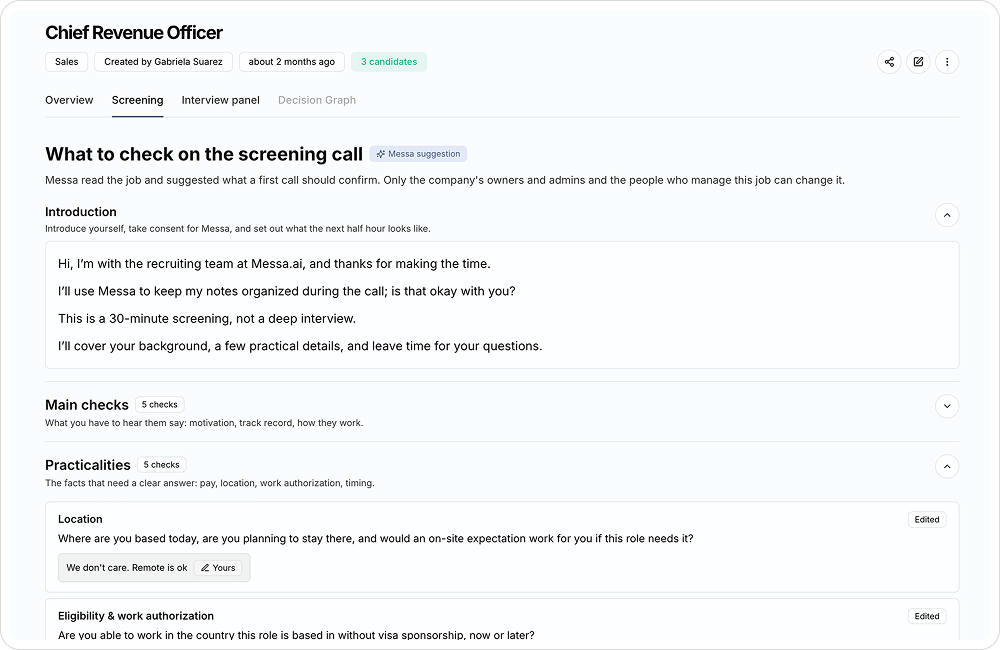
Now every job comes with a screening guide that Messa writes from the job itself. It has two parts: the main checks, and the practicalities (location, salary range, start date).
Each question comes with the answer you're looking for, so someone new on the team screens like someone who has been in the role for months. It's a fact-check, and it's very structured. As it should be. Sidekick runs the call from the guide, and the whole screening answers one question: does this candidate meet the bar to move forward?
Scorecards only help if you can compare them
In Messa, every candidate has a Summary tab. Every interviewer's decision and skillset scores live there, in one table. That makes it easy to see where the team agrees and where it doesn't, in less than 5 minutes.
This matters more than it sounds. In a debrief, the first person to speak frames the whole conversation. Often, a senior interviewer's opinion carries more weight than their evidence. One memorable quote overshadows a pattern of weaker signals. Putting everyone's decision and scores in the same view takes some of that individual power and bias away.
It also shows the gaps. If the role needs strong product thinking and only one interviewer scored it, you'll see that before deciding.
How should a debrief turn evidence into a final call?
A debrief should compare the candidate's strengths and risks against what the role needs. It isn't a popularity vote, and it isn't a contest for the strongest opinion.
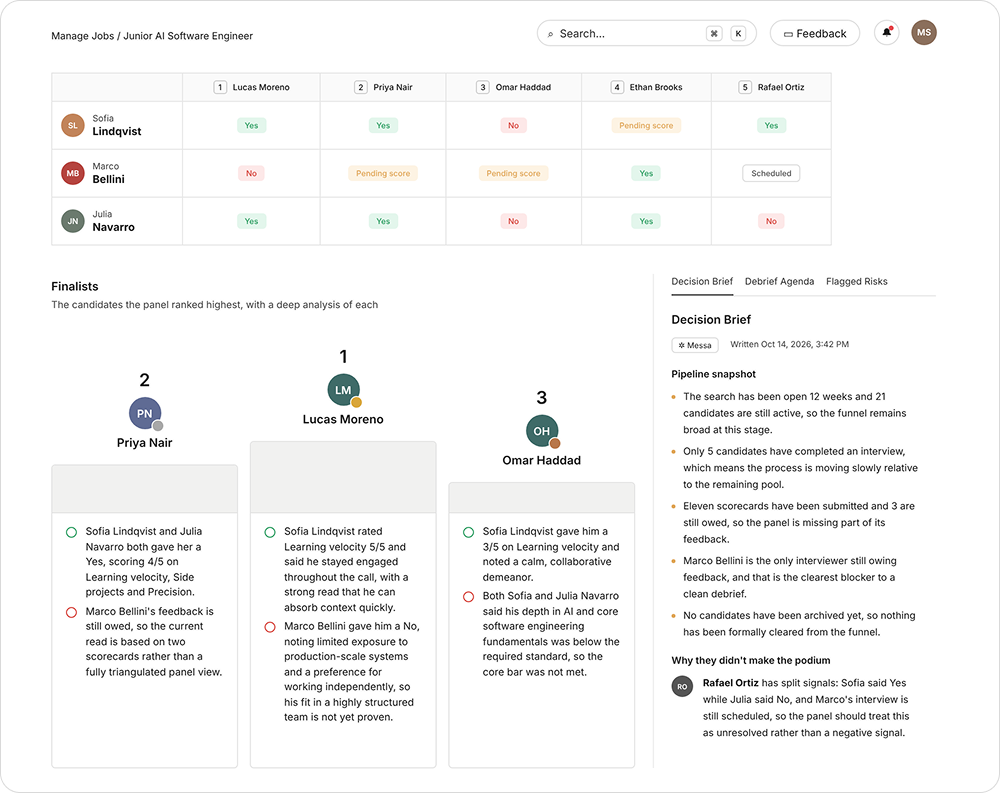
The Decision Graph puts the whole picture for a role on the table before anyone talks. It shows how each interviewer voted on each finalist, a podium of the strongest candidates, and a Decision Brief: what to discuss, where the team disagrees, and the risks someone flagged that are easy to skip when everyone is excited.
Good debriefs tend to follow the same order:
- Confirm what you're deciding: advance, reject, hold or offer.
- Go through the strongest evidence for the candidate.
- Go through the strongest evidence against.
- Decide whether they meet the bar for the role, and write down why.
The order matters. If you start with opinions, evidence becomes ammunition. If you start with evidence, opinions become interpretations you can question.
A hire is a chain of smaller decisions
Hiring will always involve judgment, because people, roles and teams are complicated. A good process doesn't remove that. It makes the judgment visible.
The interview is still the part everyone talks about. But a hire is really a chain of smaller decisions: a screening on a Monday, a scorecard on a Wednesday, a debrief on a Thursday afternoon. When each one is made with all the evidence on the table, hiring gets clearer for the team, fairer for candidates, and easier to improve.
What you can find in Messa…
- Screening: a screening guide for every job, Sidekick runs the call, and every Reject has a reason.
- Candidate Summary: every interviewer's decision and skillset scores on one page.
- Decision Graph: how the team voted on every finalist, and a brief to run the debrief.